
Texts

"Reflections and analysis on contemporary art and culture."

The CCCB is an institution that, consistently throughout its history, has defined itself as “a multidisciplinary cultural center dedicated to exploring the major themes of contemporary society through diverse languages ​​and formats.” In its thirty-two years of history, topics such as artificial intelligence, the brain, suburban culture, and figures from diverse fields—Chris Ware, Agnès Varda, Stanley Kubrick, the Marquis de Sade, and, more recently, Mercè Rodoreda—have shaped exhibition and public programs capable of offering multiple approaches and levels of interpretation.

The Cult of Beauty addresses one of these great universal themes. As Umberto Eco pointed out, beauty is an aspiration shared by all cultures, although it has never been an absolute or immutable category. Its relevance is especially significant today, when it continues to be a social construct profoundly influenced by the beauty industry, the attention economy, and social media. The exhibition stems from a cultural and political stance that doesn’t so much aim to define beauty as to analyze the mechanisms that sustain its cult.

The show is, in fact, an adaptation of the exhibition of the same name presented at the Wellcome Collection in London in 2023. The original curator, Janice Li, has been joined by researchers blanca arias and Júlia Llull, whose contributions expand the initial narrative and incorporate more pluralistic, critical perspectives, open to dissent.

The exhibition begins deliberately chronologically, guiding the visitor through classical ideals of beauty, based on principles of proportion, gender, and virtue. However, this seemingly stable narrative is interrupted by artworks that introduce fissures and raise questions. The works of Lorenza Böttner and Carlos Motta, among others, problematize these normative models and demonstrate the extent to which beauty has historically functioned as a device for inclusion and exclusion.

As the exhibition progresses, dichotomies such as beautiful/ugly or virtue/failure begin to crumble, although others continue to operate strongly, especially the association between beauty and youth. Forms of exclusion persist, albeit in new configurations. From colonial exoticism, capable of objectifying any form of otherness, we move to contemporary mechanisms of invisibility linked to race, gender, or identity. In response, trans, queer, and non-binary collectives have developed strategies of self-expression, resistance, and the construction of collective memory. In this context, Colita’s portraits dedicated to the Roma community, Angélica Dass’s Humanae project, with its wide spectrum of skin tones, and Norma Pérez’s trans portraits engage particularly effectively with the exhibition’s themes.

The exhibition then delves into the complex relationship between beauty, medicine, and science. From the cosmetic practices of ancient Egypt to the anatomical ideals of the Renaissance, the journey leads to the present, where the obsession with image—an extreme result of the society of the spectacle—is amplified by the commercialization of pharmaceuticals, aesthetic treatments, and surgical procedures. The new standards are no longer necessarily associated with proportion or virtue, but increasingly with purchasing power. Beauty thus appears as a privilege that can be bought, with consequences that affect both physical health and emotional well-being. How can we identify these forms of control in order to conquer greater spaces of autonomy? Where does individual desire end and collective pressure begin? The works of Marina Vargas and Arvida Byström point precisely to this overflowing of normative limits, making visible the restrictions that underlie any standard.

The installation Mirror, Mirror on the Wall, by Xcessive Aesthetics, places the visitor before a distorting mirror that reflects the visual pollution that accompanies our daily experience. An incessant flow of images, filters, algorithms, and aspirational models that we consume through social media, from which it is increasingly difficult to escape, raises numerous questions: Who establishes the standards of beauty today: cultural institutions, the beauty industry, algorithms, or social media? How do filters, artificial intelligence, and digital editing affect our perception of ourselves? Can there be an aesthetic of difference that is not absorbed by the market? Are we witnessing a democratization of beauty or a sophistication of its control mechanisms? Is it possible to imagine a society less obsessed with appearance? What do we lose when we have we turned beauty into an obligation?

But The Cult of Beauty is not confined to the exhibition space. As is usual at the CCCB, the project is expanded through a robust public program featuring thinkers and specialists such as Eloy Fernández Porta, Remedios Zafra, and the curators themselves. In addition, there is an educational program for LGBTQ+ youth, coordinated by Cordova and developed in collaboration with artists like ¥E$Si PERSE and Toni Hervás, as well as the film series Beautiful and Eternal, curated by Desirée de Fez for Las Gandules 2026. The selection of fantasy and science fiction films addresses issues such as youth, aesthetic pressure, and the obsession with preserving beauty, extending many of the questions raised by the exhibition onto the screen.

Rather than offering definitive answers, The Cult of Beauty invites us to critically reconsider an idea we often take for granted. Because, if beauty has never been a neutral category, perhaps the real challenge lies in asking ourselves who defines it, who benefits from it, and who inevitably falls outside its boundaries.

The exhibition The Cult of Beauty, curated by Janice Li, blanca arias, and Júlia Llull, along with its accompanying public program, can be visited and followed at the CCCB until November 8, 2026.
 

[Artícle published in A*DESK 5-8-2026]

Text on the field of visual arts for the Annual Report: State of Culture and the Arts 2025

The CoNCA Annual Report is a public document that analyses the state of culture and the arts in Catalonia, reviewing the main trends, data and cultural policies of the previous year. It also evaluates the action of public administrations in cultural matters and identifies structural challenges in the sector. Finally, it proposes strategic recommendations to strengthen the Catalan cultural ecosystem and guide future policies.

Recently, curator Àngels Miralda published in Frieze magazine (February 2026) the article Who Killed the Independent Curator?, a text that takes me back to the early 2000s (not without a certain feeling of vertigo) when, in the context of the Curatorial Program of the De Appel Foundation in Amsterdam, the figure of the international independent curator occupied a central place and names such as Hans-Ulrich Obrist, Maria Lind or Hou Hanru were common references.

This figure, heir to the legacy of Harald Szeemann and projects such as When Attitudes Become Form (1969), placed the emphasis not only on artistic concepts and processes, but above all on complicity with artists and critical dialogue with the institution. Without being part of the institutional organization chart, the independent curator played a mediating role between artists, institutions and audiences, generating spaces of productive tension.

Today the scenario is very different. Independent professionals (artists, curators, curators or mediators) become small one-person businesses that must simultaneously assume management, communication, dissemination and production, in addition to conceptual and research work. This multiplicity of roles responds less to a choice than to a structural precariousness of the sector. At the same time, contemporary art competes for attention in societies saturated with stimuli, where the visual impacts of social networks and the entertainment industry often displace the slow temporality of research and critical thinking. Although to what extent Bad Bunny’s performance at the Super Bowl can be as or more political than full museum programs talking about decolonization is another matter. Economic resources exist, but they are distributed unevenly: they are abundant for major museum expansions or emblematic institutions, while they arrive in trickles to the independent cultural fabric, often in the form of subsidies that generate budgetary uncertainty until well into the middle of the year.

In his article, Miralda also points out the consolidation of a model in which the artistic direction of major biennials falls to those responsible for large institutions, favoring the repeated circulation of artists and discourses and producing a homogenization that limits plurality.

However, consolidated institutions share with independent initiatives the desire to think about the present, preserve heritage and imagine fairer futures, although this aspiration is often strained by their own structures. The solution would not be so much to oppose the institution, but to activate numerous instituting practices between art and politics that allow the implementation of multiple institutional forms that can be complementary and truly transformative.


[Text published in Bonart magazine number 203, March 2026]


“Unveiling the structures of power and control through photography” is the leitmotif of Paula Artés’s work. Starting with a background in photography, her practice has progressively shifted its focus toward the research process, incorporating methodologies from critical and political analysis. In the systems she examines, she identifies mechanisms of power and control that operate from a distance, invisibility, or intangibility.

In various projects he has addressed the opacity of a state body, the Civil Guard, understood as an operational system of police control (Fuerzas y cuerpos [Forces and bodies], 2016-2018); the exploitation of the natural environment and the forms of regulation exercised by large oligopolies (Energía sumergida [Submerged energy], 2018-2024; El caudal del río [The flow of the river], 2021-2025); or the VIP space in a sporting context as a place of agreements with great political and economic impact (Palco de honor [Honorary box], 2025), to mention only a few.

Firma, [Sign,] (2017-2019) is not her most recent work, although the passage of time has added new layers of meaning. Begun as a final year project under the supervision of Tanit Plana and Marta Dahó, Firma, marks a turning point in Artés’s work by giving central weight to research as a constitutive part of the piece. Firma, is structured around a series of direct and profoundly political questions: What does the State know about us? How much personal information does it manage? From where does it exercise control? What use does it make of this data? These questions serve as catalysts to sharpen our position as critical citizens.

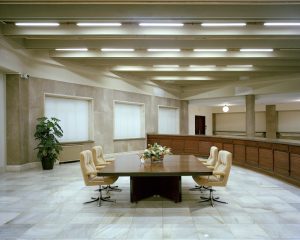
The exhibition, titled Firma, focuses on official spaces that collect and manage our data—medical centers, civil registries, funeral homes, libraries, post offices—which the artist photographs using a large-format camera and an analog process. The images depict anonymous, prototypical, and perfectly interchangeable places, devoid of any trace of human presence. The carefully chosen framing evokes dead ends: spaces without exits, corridors without vanishing points, permeated by a Kafkaesque atmosphere. These are images that reflect the bureaucratic aspects of our lives, now indistinguishable from the vital ones.

In parallel, Artés compiles a large number of documents from these same spaces, forms requesting personal information that repeatedly culminate in the same imperative verb: “sign.” Sometimes accompanied by a comma intended to soften the command, other times followed by a colon, but always stated as a mandate. A seemingly banal gesture that condenses the transfer of rights, data, and responsibilities into a single act.

Photographs and documents thus create a portrait of the state’s administrative structure as a contemporary panopticon. Bentham’s prison design (a central tower from which inmates are watched without their knowledge) and its reformulation by Michel Foucault, as a technology of power extendable to the whole of society, acquire new significance in the context of accelerated digitalization, especially since the 2020 pandemic.

The artist’s book(1) that is part of the project includes a revealing conversation between Paula Artés and Gemma Galdón Clavell, PhD in security and technology policy and public policy analyst. It reflects on how the modern state is founded on data management as a form of organization and control, and how bureaucracy plays a key role in its historical constitution.

With digitalization, this capacity for control increases exponentially. The data we voluntarily provide is intertwined with that collected involuntarily, generated by our daily activities, from the purchases we make to the routes we take, the services we use, and the platforms we consult. We are more monitored, but less aware of it, and paradoxically, we have less control over our own data.

The technofeudalism (2) described by Yanis Varoufakis is no longer a theoretical abstraction but a palpable reality. The primary purpose of digital data infrastructures is not to make our lives easier or expand our rights, but rather to maximize the profitability of large global technology corporations.

The spaces photographed by Paula Artés still exist, although their functions have been radically transformed. It is no longer necessary to physically travel to complete a transaction: one or a few clicks are all it takes. Data then ascends to what we call “the cloud,” a poetic and seemingly innocuous term that masks the proliferation of physical data centers, which are highly resource-intensive, especially in terms of water and electricity, with an increasingly evident ecological and geopolitical impact.

The disappearance of physical space does not imply the disappearance of control, but rather its intensification. Power no longer needs monumental architecture or a visible presence; it operates in a distributed, opaque, and automated manner. Bureaucracy, far from diminishing, becomes more efficient, faster, and more difficult to challenge. The act of signing, now transformed into accepting, checking a box, or swiping a finger, occurs more frequently and with less awareness of its consequences. This signature places us before a central paradox of contemporary democracies: the more streamlined administrative systems become, the less room there is for dissent. Consent becomes a formality, and responsibility shifts to the individual, while the infrastructures of power remain outside our field of vision. Invisibility thus becomes a fundamental political strategy. What is not seen is not questioned, and what is not questioned becomes normalized.

In this sense, Paula Artés’s project traces a critical cartography of the present, in which control is not imposed by force, but rather managed through protocols, interfaces, and administrative languages ​​that we have learned to accept as inevitable.

Understanding these mechanisms, making them visible, and naming them is a profoundly political act. It does not guarantee emancipation, but it is an indispensable condition for imagining it. Because only that which is understood can be questioned, and only that which is questioned can, eventually, be transformed.

(1) Artés, Paula, Firma. Cuaderno de la Kursala, nº 90. Universidad de Cádiz, 2025.
(2) In Varoufakis, Yannis’ Technofeudalism: What killed Capitalism (Bodley Head, 2023), the author identifies the owners of what he calls “cloud capital” as new feudal lords, turning us into serfs. The consequence is increased inequality.
Paula Artés, Firma,

[This text accompanies the exhibition Firma, by Paula Artés at the Centre Cultural Melchor Zapata, Benicássim. 19 February – 26 April 2026]

Matthew Lopez’s play The Inheritance is about different generations of gay men in New York City: those of today and those of yesterday, those who fought for their rights and against AIDS and its stigmatization. The legacy referred to in the title is “that of history, community and self.”

In recent months we have lost two people to whom we owe a lot. Montse Guillén lived in New York in the 1980s and suffered the loss of many of her friends. One of them, Keith Haring, had her help in managing the permits and finding a location in Barcelona for the mural Tots junts podem parar la sida (Together we can stop AIDS) (1989). Miralda’s partner and accomplice, Montse Guillén made a unique contribution with her way of linking culinary innovation with artistic creativity. With Miralda they created the restaurant El Internacional in New York and the FoodCultura project, a visionary proposal that explores the interrelationships between cuisine, art and science, and that collects, archives and activates aspects of human identities, rituals and culinary traditions. Montse was an active, energetic, laughing person and always ready to embark on new adventures.

Just a few weeks later, Antoni Mercader, a pioneer of multimedia art in our country and member of the Grup de Treball, where he met Muntadas, among others, also left us. He was co-author, together with Eugeni Bonet, of the first book on video art published in Spain: En torno al vídeo (1980). For a couple of years, he was in charge of the Dilluns de Vídeo in La Virreina, programming representative tapes of the evolution of the medium. He played a key role in defining the Mediateca de la Caixa, directed by Carme Garrido, conceived as a large accessible archive that focused on the social use of new media. But, above all, Antoni Mercader was a generous person who shared his experience and knowledge while building bridges between generations of artists, critics and curators.

The generations that came after us, and also those that have come —and will come— after us, owe an immense debt to Montse Guillén and Antoni Mercader. For them, for Montse and Antoni, we are left with a deep feeling of esteem, homage and, above all, gratitude.


Article published in BONART 202. Autumn-Winter 2025

There is frequent discussion around how different players in the art ecosystem are redefining their roles and working models. Hauser & Wirth stands out in this regard—not only as one of the most influential galleries on the global art scene, but also for how it has developed each of its spaces in distinct ways, incorporating elements of environment and well-being that enrich the experience for collectors, clients, and visitors alike. Hauser & Wirth Menorca is a prime example, bringing together nature, sustainability, and a certain sense of exclusivity.

But this is not the time to analyze gallery models. Rather, we turn to the two exhibitions currently on view at this unique venue—solo shows by two artists with firmly established careers: Mika Rottenberg and Cindy Sherman.

Cindy Sherman. The Women

Encountering Cindy Sherman’s work is always noteworthy—especially considering that her last solo exhibition in Spain took place back in 1996 at the Museo Nacional – Centro de Arte Reina Sofía in Madrid, co-organized with the Boijmans Van Beuningen Museum in Rotterdam.

On this occasion, The Women brings together a compelling selection of works created between the 1970s and 2010s. Among them are some of her most iconic series, such as Untitled Film Stills (1977–1980), where Sherman stages fictional film stills that evoke the nouvelle vague, 1960s French cinema, Italian neorealism, and even Hitchcock.

This is the only series to which Sherman has assigned a title. As she explains in a documentary produced by Art21—screened as part of the exhibition—she generally avoids titling her works, feeling she isn’t particularly skilled at it and preferring instead to leave room for ambiguity and multiple interpretations. The show in Menorca also includes early pieces from her student years, already foreshadowing the aesthetic and conceptual approach of Untitled Film Stills. In these early images—as in much of her work—Sherman uses makeup, wigs, masks, and costumes, performing as model, director, and photographer by triggering the camera herself from within the scene. Also featured are selections from the Murder Series, where she embodies mysterious, everyday characters that anticipate some of the figures later seen in her commercial film Office Killer (1997).

The heart of the exhibition, however, lies in her later explorations of women—middle-aged, from diverse social and economic backgrounds—placed in enigmatic settings. Sometimes these are dramatic, painterly landscapes that starkly contrast with the haute couture garments worn by the characters (in collaboration with Vogue and Harper’s Bazaar); other times, the works rely on layered compositions and double exposures.

The series informally known as The Flappers revisits different archetypes of women from the 1920s, ’30s and ’40s—figures who embodied empowerment and a desire to modernize society. These works also introduce themes of aging and the passage of time. One of the highlights of the documentary mentioned before shows Sherman in her studio, where she reveals drawers filled with dental prosthetics, ocular accessories, and masks. We also see her enthusiastically thrift-shopping for outfits—animal prints, sequins, and all manner of glittery attire—which often inspire the emergence of new photographic characters.

Her ongoing investigation into identity construction through self-representation—a central theme of her practice—feels particularly prescient in today’s era of social media, especially Instagram. Fittingly, one can find the cindyshermanlegacyproject on that very platform—an initiative by Hauser & Wirth devoted to preserving her photographs and ensuring the longevity of her artistic legacy.

Mika Rottenberg. Vibrant Matter

Mika Rottenberg’s Vibrant Matter blurs the line between reality and fiction to explore post-capitalist life systems and how they shape our existence. Her immersive installations and video works often confront viewers with absurd mechanisms of labor, production, and consumption. Two major pieces featured in the show are Cosmic Generator (2017)—first presented at Skulptur Projekte Münster—and Spaghetti Blockchain (2019).

Cosmic Generator weaves together real and imaginary scenes linking distant places such as Mexico, California, and a plastic goods market in China. Spaghetti Blockchain, meanwhile, focuses on materials—from raw substances to artificial textures, or the tiniest particles documented during a research stay at CERN. This three-channel video installation includes a meticulously crafted soundscape, incorporating everything from plastic ball manipulation and ASMR-style effects to traditional Siberian throat singing, generating immersive connections to both space and nature.

This sonic dimension also enriches the visit to her latest installation, Lampshares (2024–2025), in which Rottenberg transforms her New York studio into a kind of circular economy. Created in collaboration with Inner City Green Team and Gary Dusek, this series of lamps is made from invasive vines gathered in upstate New York and recycled plastic sourced from local dumpsters. In doing so, Rottenberg builds functional sculptures from materials often considered waste or toxic. Yet these substances, derived from petroleum, originate from once-living organisms millions of years ago. By repurposing such detritus, the artist performs a gesture of transformation—redefining the negative connotations of these materials and postponing their environmental impact through renewed utility.

Cindy Sherman. The Women y Mika Rottenberg. Vibrant Matter are on view at Hauser & Wirth Menorca through 26 October 2025.

Article published in A*DESK 3-7-2025

In June 2020, Berlin’s legendary techno club Berghain, closed during the pandemic, reopened to present the Studio Berlin exhibition, featuring work by 117 artists living in the city. One of them, Rirkrit Tiravanija, presented an installation outside the building with the phrase “Morgen ist die Frage” [Tomorrow is the question].

Four years later, this phrase and this reference to Tiravanija appear in the work Totentanz. Morgen ist die Frage, by the company La Veronal, a creation that was presented at the Teatre Lliure and that brings together an installation, a video and a performance that brings medieval dances of death into the present.

There are many parallels between the medieval era and the present. If the former was a time of wars, plagues, misrule, banditry, insurrection, religious divisions and schisms, in the present moment, called technofeudalism by the economist Yanis Varoufakis, the feudal lords are the owners of the “cloud capital” and the rest of us are serfs, a new system of exploitation that causes inequality to increase. Indefiniteness and uncertainty reopen wounds, frustrations, millennial fears and become fertile ground for simple and populist missives. The medieval dances of death were a way of overcoming fear. The fear of death and insecurity; a fear that in our societies is also associated with the loss of values and an overreaction to ward it off through excess (of images, productions, noises, activities, opinions…). The final video of Totentanz, with an avalanche of images of an overflowing present (wars, violence, parties, masses, protests, genocides…), leaves us breathless. Perhaps this is the current way of neutralizing fears, with an excess of images and noises that hypnotizes us. While this state of shock lasts, censorship reigns with total impunity (the one that asks not to make compromising political statements, point out injustices or, directly, cancels).

But the dances of death are also a catharsis after which new things can emerge. The Middle Ages were not a uniform period, but between the 11th and 15th centuries the foundations of the Renaissance were laid, as well as a scientific interest in the investigation of nature, empirical knowledge and the phenomena of the universe. In the present, aspects of different moments coexist, the difference being that all those changes that in the past took centuries can now take place in a few years. It is essential to be attentive to analytical analogies to understand the current international system, but unlike how scholars of international politics or sociology would do it, those who can best work on these analogies are the artists who, in a free way, generate spaces for thought and lucidity.

[Article published in Bonart, March 2025]